When Helium Leak Testing Is Needed — and When It Is Not
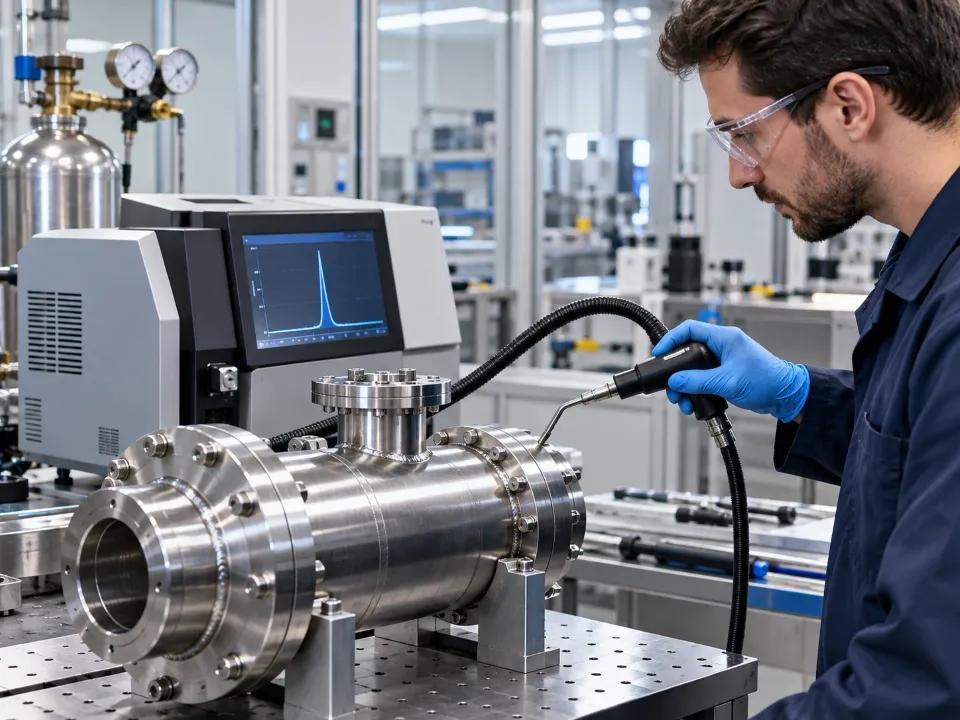
Not every leak test needs helium. In many cases, a pressure decay test, bubble test, vacuum box test, or visual inspection may be enough.
But when a facility needs to find very small leaks, verify vacuum integrity, meet a tight leak-rate requirement, or provide traceable documentation, helium leak testing may be the right method.
For Tennessee manufacturers, this matters in industries like aerospace, defense, pharmaceutical production, cleanroom operations, energy, nuclear, research, data centers, and advanced manufacturing. These facilities often need more than a simple pass-or-fail check. They need clear leak-rate information and documentation their QA, maintenance, or customer teams can use.
For local support, visit our [Leak Testing Services in Tennessee](/services/non-destructive-testing-services/leak-testing).
Quick Answer: Helium leak testing is needed when the acceptable leak rate is very small, the system must hold vacuum or pressure, the part is sealed or high-value, or the customer requires quantitative leak-rate documentation. It may not be necessary when a bubble test, pressure decay test, vacuum box test, or visual leak check can prove the requirement with enough confidence.
What Is Helium Leak Testing?
Helium leak testing uses helium as a tracer gas to find or measure leaks in sealed parts, systems, and components.
A helium leak detector, often a mass spectrometer, identifies helium that moves through a tiny leak path. The test may help locate a leak, measure a leak rate, or verify that a part meets a required leak limit.
The ASNT leak testing overview explains leak testing as a method used to evaluate sealed-system integrity. It may involve visible bubbles, pressure change over time, or detection of a tracer gas such as helium moving through a tiny opening.
Helium is commonly used because it is small, inert, and detectable at very low levels. The test setup depends on the part, the required sensitivity, the acceptance criteria, and whether the technician needs to locate a leak or measure a leak rate.
When Helium Leak Testing Is Needed
Helium leak testing is most useful when the leak requirement is too sensitive for simpler methods, or when the result must be measured and documented.
When the Leak Must Be Very Small
Use helium leak testing when the acceptable leak is smaller than what bubble testing or basic pressure decay can reliably prove.
This is common for:
- sealed components
- precision assemblies
- vacuum systems
- high-value parts
- near-hermetic components
- critical enclosures
- aerospace or defense parts
Many leak testing guides describe helium as a higher-sensitivity method than bubble or pressure-decay approaches, especially where very small leaks matter. This helium leak testing guide gives a useful overview of where helium testing fits.
When You Need a Quantitative Leak Rate
Some projects do not just need “leak” or “no leak.” They need a measured leak rate.
Helium leak testing may be needed when:
- a customer provides a maximum allowable leak rate
- QA needs documented acceptance evidence
- a repaired component needs verification
- production release depends on measured results
- a sealed assembly needs proof before shipment
A quantitative result helps teams decide whether to accept, repair, rework, or reject the part.
When Vacuum Integrity Matters
Helium testing is often useful when a system must hold vacuum.
This may include:
- vacuum chambers
- research systems
- sealed enclosures
- cleanroom-related equipment
- high-vacuum components
- energy or nuclear-related assemblies
The right setup depends on whether the system can be pressurized, evacuated, isolated, or tested with tracer gas. If a facility needs broader inspection support, TN NDT also provides NDT services in Tennessee.
When the Leak Location Must Be Found
Sometimes the problem is not only whether a leak exists. The team also needs to know where it is.
Sniffer helium leak testing can help locate leaks around:
- weld seams
- fittings
- valves
- flanges
- seals
- joints
- tubing connections
This comparison of sniffer vs vacuum helium leak testing explains how sniffer mode is often useful when the goal is identifying the physical leak location, while vacuum methods are more useful for measured leak-rate testing under defined conditions.
When the Component Is High-Value or Cannot Be Destroyed
Helium leak testing is useful when destructive testing is not practical.
This matters for:
- aerospace components
- medical or pharmaceutical assemblies
- machined parts
- sealed electronics
- specialty manufacturing parts
- vacuum feedthroughs
- heat exchangers
- custom assemblies
If the part is expensive, difficult to replace, or already near shipment, nondestructive leak testing can support the decision without cutting the part open.
When Helium Leak Testing Is Not Needed
Helium leak testing is powerful, but it is not always the best first choice.
A trustworthy leak testing plan should match the method to the requirement.
When the Acceptable Leak Is Large
If the acceptable leak limit is relatively large, a simpler test may be enough.
A bubble test, pressure decay test, or vacuum box test may confirm the requirement faster and at lower cost.
When a Bubble Test Can Clearly Locate the Leak
If a leak is visible, accessible, and not tied to a tight leak-rate requirement, bubble testing may be practical.
Bubble testing can be useful when the goal is simple leak location, not high-sensitivity measurement.
When Pressure Decay Meets the Requirement
Pressure decay testing is widely used in manufacturing. It may be the right choice when the acceptance limit does not require helium sensitivity.
This guide on choosing the right leak test method explains how method choice depends on the part, leak-rate requirement, and production need.
Pressure decay can be useful for production testing, larger leaks, and parts where a pressure drop over time is enough to prove the requirement.
When the Part Cannot Be Properly Prepared
Helium leak testing may not be practical if the part cannot be sealed, pressurized, evacuated, isolated, or shielded from background helium.
Poor setup can create confusing results.
When the Real Need Is Structural Strength Testing
Leak testing and structural strength testing are not the same.
A hydrostatic test may help verify pressure strength. Helium leak testing verifies leakage. One does not automatically replace the other.
If the concern is structural integrity, pressure strength, or material condition, another inspection or test method may be more suitable. For example, Ultrasonic Testing may help with wall thickness checks or internal material concerns, while leak testing focuses on whether gas or liquid can pass through a leak path.
Helium Leak Testing vs Pressure Decay, Bubble Testing, and Vacuum Box Testing
Different leak testing methods answer different questions.
| Method | Best For | Main Limitation |
|---|---|---|
| Helium Leak Testing | Very small leaks, vacuum integrity, measured leak rate | More setup and specialized equipment |
| Pressure Decay | General production leak testing and larger leaks | May miss very small leaks |
| Bubble Testing | Simple visible leak location | Less sensitive and less quantitative |
| Vacuum Box Testing | Accessible weld seams and surface leaks | Limited to accessible surfaces |
| Visual Inspection | Obvious damage or workmanship issues | Cannot prove tight leak-rate requirements |
The right method depends on the leak-rate requirement, part design, access, customer specification, and documentation needs.
If your team only needs to prove a general pressure-hold requirement, pressure decay may be enough. If your team needs a very low leak-rate result, helium leak testing may be the better method.
When the concern is visible damage, weld condition, or workmanship, Visual Inspection may be a useful starting point.
Sniffer Mode vs Vacuum Mode Helium Leak Testing
Helium leak testing can be performed in different ways. Two common approaches are sniffer mode and vacuum mode.
Sniffer Mode
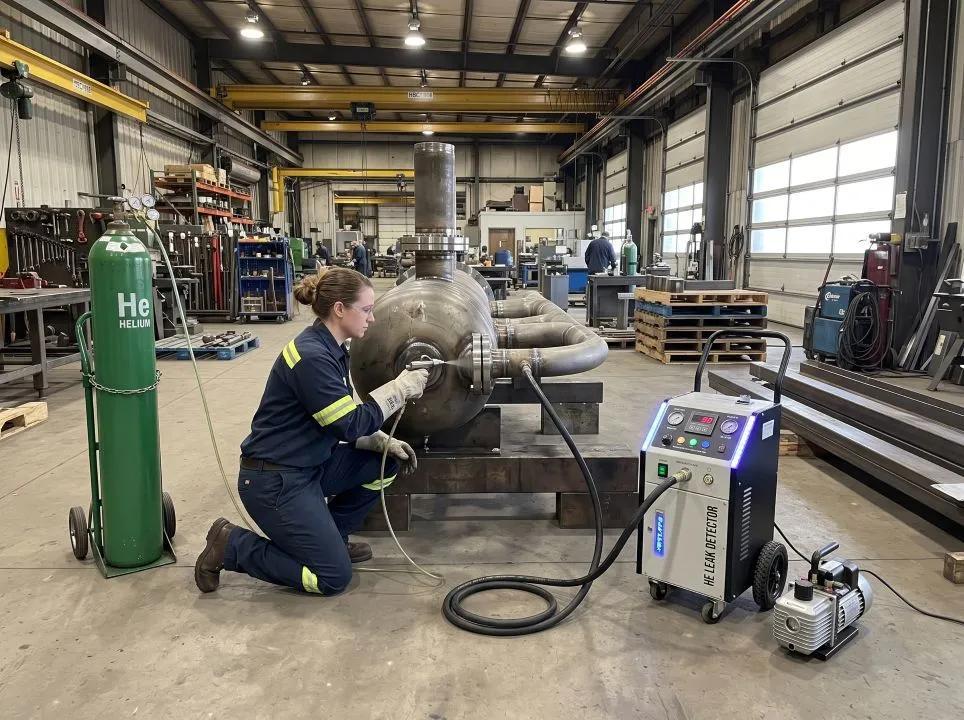
In sniffer mode, the part is usually pressurized with helium or a helium mixture. The technician scans the outside with a sniffer probe.
Sniffer mode is useful when the technician needs to find the leak location.
It is often used around:
- fittings
- welds
- seals
- joints
- valve bodies
- flange connections
Sniffer mode is flexible, but it may be less sensitive than vacuum-mode testing in some applications.
Vacuum Mode
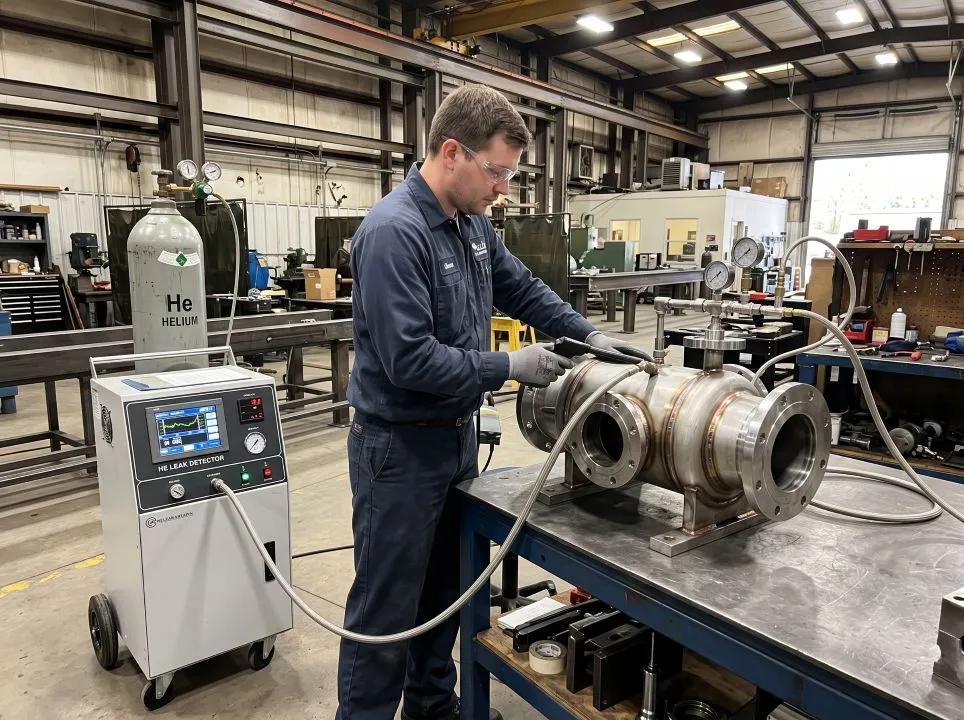
In vacuum mode, the part, chamber, or test setup is connected to a leak detector under vacuum. Helium is introduced outside the suspected leak area, or the part is placed in a helium environment depending on the setup.
Vacuum mode is often used when higher sensitivity or quantitative leak-rate verification is needed.
Which Mode Should You Use?
Use sniffer mode when the main goal is finding the leak location on an accessible part.
Use vacuum mode when the main goal is proving a small leak-rate requirement or verifying vacuum integrity.
In many cases, the best choice depends on the part geometry, test requirement, access, and whether the team needs leak location, leak rate, or both.
Industries That May Need Helium Leak Testing in Tennessee
Helium leak testing supports facilities where leakage can affect safety, quality, uptime, or customer acceptance.
Aerospace & Defense
Aerospace and defense suppliers may need leak testing for sealed components, precision assemblies, hydraulic systems, fuel-related components, or customer-required documentation.
Helium testing is useful when a small leak could affect quality or acceptance.
Pharmaceutical & Cleanroom Facilities
Pharmaceutical and cleanroom facilities may need leak testing for contamination-sensitive systems, sealed process components, controlled environments, and cleanroom-related assemblies.
Helium testing can support applications where small leaks matter and documentation is important. Facilities with controlled environments may also need clean room testing or HEPA filter testing.
Energy, Nuclear & Research Facilities
Energy, nuclear, and research facilities may use helium testing for vacuum systems, heat exchangers, sealed assemblies, test chambers, and critical components.
This is especially relevant in Tennessee industrial regions connected to advanced manufacturing, energy, and research work.
Manufacturing & Fabrication
Manufacturing and fabrication teams may use helium leak testing for tanks, vessels, welded assemblies, process equipment, machined parts, valves, and sealed systems.
This is common when standard leak checks do not provide enough sensitivity or documentation.
Data Centers & AI Centers
Data centers and AI centers may need leak testing for cooling-related systems, sealed components, and critical infrastructure where leaks can affect uptime.
For high-value systems, a clear leak test result can help maintenance and facility teams make better decisions.
Common Signs You May Need Helium Leak Testing
You may need helium leak testing if:
- the part passes visual inspection but still loses pressure
- a pressure decay test fails but does not show where the leak is
- a vacuum system cannot hold target vacuum
- a customer requires leak-rate documentation
- a sealed component must meet a tight specification
- the leak is too small for bubble testing
- a repaired part needs verification
- a high-value part cannot be cut open for testing
- repeat leaks keep appearing after assembly or repair
These situations often need more than a basic leak check. They need a method that can provide clearer evidence.
What Should a Helium Leak Testing Report Include?
One common frustration with leak testing is unclear reporting. A useful report should not leave QA, maintenance, production, or customer teams guessing.
A good helium leak testing report may include:
- part or system identification
- test method used
- sniffer mode or vacuum mode
- test pressure or vacuum condition
- helium concentration if applicable
- detector or equipment details when needed
- calibration or traceability details
- leak rate and units
- leak location if applicable
- acceptance criteria when provided
- technician notes and recommendations
Clear reporting helps teams decide whether to accept, repair, monitor, rework, or reject the part.
For regulated, customer-driven, or audit-sensitive work, documentation can be as important as the test itself.
Why Choose TN NDT for Helium Leak Testing in Tennessee?
Facilities do not request helium leak testing just to get a technical result. They request it because a shipment, repair, production release, facility decision, or customer requirement depends on the answer.
A Tennessee manufacturer may need leak-rate documentation before shipping a sealed component. A cleanroom facility may need leak testing for a contamination-sensitive system. An energy or research facility may need high-sensitivity testing on a vacuum-related assembly.
In each case, the value is not only finding a leak. It is choosing the right method, testing correctly, and delivering clear documentation that helps the team decide the next step.
TN NDT supports:
- helium mass spectrometer leak detection
- leak testing services in Tennessee
- ASNT-certified technicians
- NIST-traceable standards where applicable
- clear, audit-ready reporting
- practical recommendations
- related NDT services when needed
Need help choosing the right leak test method?
FAQs About When Helium Leak Testing Is Needed
What is helium leak testing?
Helium leak testing uses helium as a tracer gas and a leak detector to find or measure leaks in sealed parts, systems, or components.
When is helium leak testing needed?
Helium leak testing is needed when the acceptable leak rate is very small, vacuum integrity matters, a customer requires measured leak-rate documentation, or other leak methods are not sensitive enough.
When is helium leak testing not needed?
It may not be needed when a bubble test, pressure decay test, vacuum box test, or visual inspection can prove the requirement clearly and cost-effectively.
Is helium leak testing better than pressure decay?
Not always. Helium is usually better for very small leaks and measured leak-rate testing. Pressure decay may be better for general production testing when the leak threshold is larger.
What is the difference between sniffer and vacuum helium leak testing?
Sniffer testing helps locate accessible leaks on pressurized parts. Vacuum testing is often used when higher sensitivity or quantitative leak-rate verification is needed.
Can helium leak testing find very small leaks?
Yes. Helium testing is often used when very small leaks must be detected or measured.
Does TN NDT provide helium leak testing in Tennessee?
Yes. TN NDT provides leak testing support in Tennessee, including helium mass spectrometer leak detection where appropriate.
What industries use helium leak testing?
Aerospace, defense, pharmaceutical, cleanroom, energy, nuclear, research, manufacturing, fabrication, and data center facilities may use helium leak testing.
Voice Search Questions:When should a manufacturer use helium leak testing?Who provides helium leak detection in Tennessee?
Key Takeaways
Helium leak testing is useful when very small leaks, vacuum integrity, measured leak rates, or clear documentation matter.
It may not be needed when pressure decay, bubble testing, vacuum box testing, or visual inspection can prove the requirement with enough confidence.
Sniffer mode is often useful when the goal is finding the leak location. Vacuum mode is often better when the goal is proving a small leak-rate requirement.
TN NDT helps Tennessee facilities choose the right leak testing method, perform the test correctly, and document results clearly.
Need leak testing support in Tennessee?