Helium Leak Detection vs Pressure Decay: Which Leak Test Should You Use?
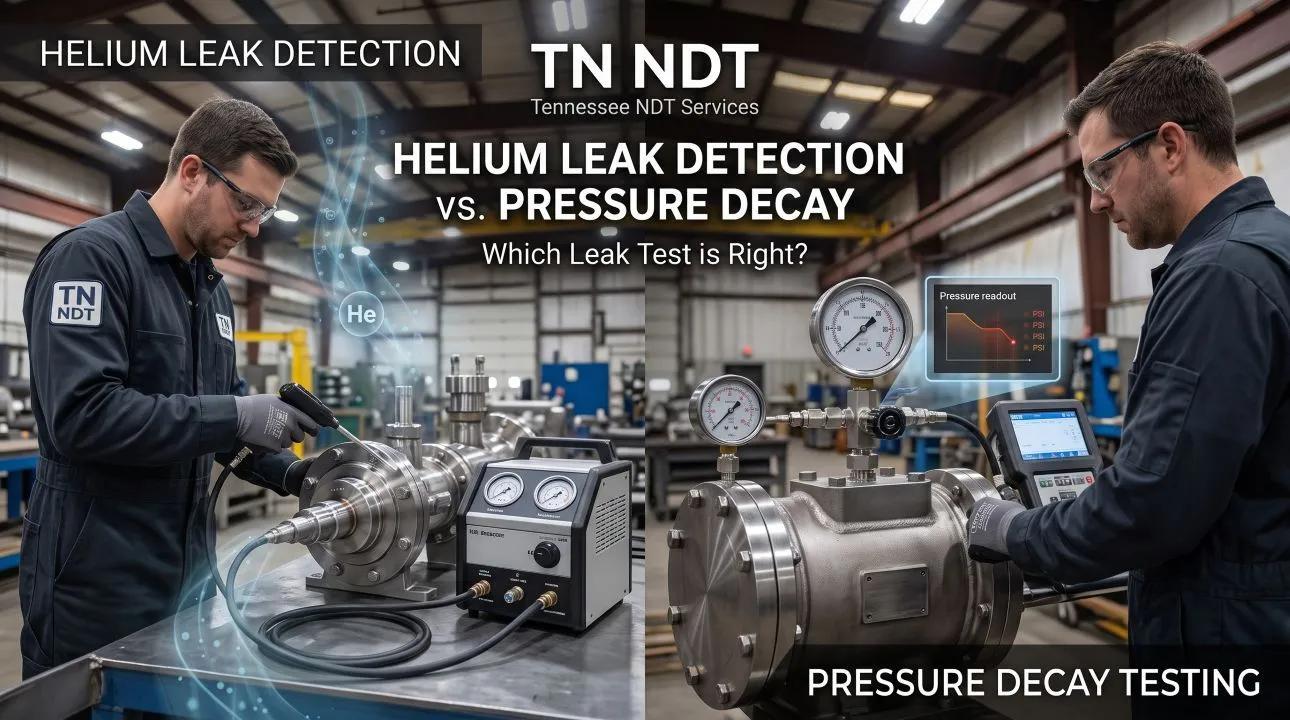
Leak testing is not one-size-fits-all. A test that works well for a general production part may not be sensitive enough for a sealed aerospace component, vacuum system, cleanroom assembly, or high-value manufactured part.
Two common options are helium leak detection and pressure decay leak testing. Both are useful. But they answer different questions.
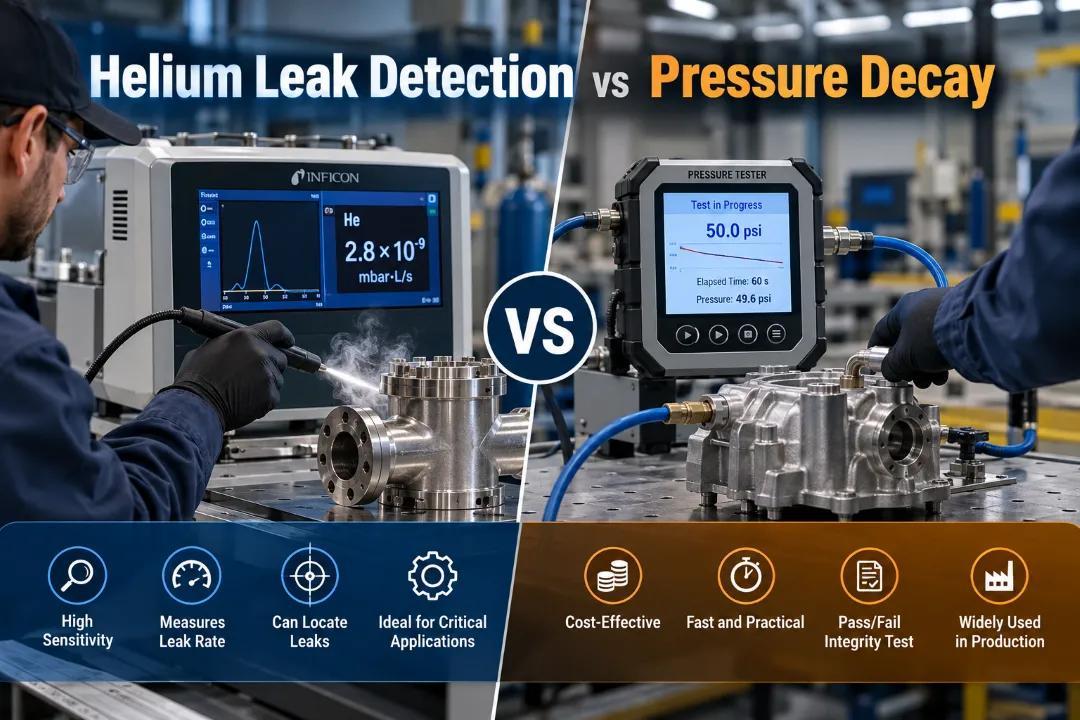
Pressure decay is often a practical choice for routine production leak checks. Helium leak detection is usually better when the leak must be very small, the result must be measured, or the part must meet a tighter leak-rate requirement.
For local support, visit our [Leak Testing Services in Tennessee](/services/non-destructive-testing-services/leak-testing).
Quick Answer: Use helium leak detection when you need high sensitivity, measured leak-rate documentation, vacuum integrity testing, or leak location support. Use pressure decay when you need a simpler pass/fail production test and the acceptable leak threshold is not extremely small.
What Is Helium Leak Detection?
Helium leak detection uses helium as a tracer gas to find or measure leaks in sealed parts, systems, or components.
A helium leak detector, often a mass spectrometer, identifies helium that moves through a leak path. Depending on the setup, helium testing can help locate a leak, measure a leak rate, or confirm that a part meets a customer requirement.
The ASNT leak testing overview explains that leak testing can involve pressure change, visible bubbles, or tracer gas methods such as helium to evaluate sealed-system integrity.
Helium leak detection is often used when small leaks matter.
Common applications include:
- vacuum systems
- sealed components
- aerospace and defense assemblies
- cleanroom and pharmaceutical systems
- energy and research components
- high-value manufacturing parts
- welded assemblies with tight leak requirements
Helium testing usually requires more setup than a simple leak check, but it can provide a more sensitive and measurable result.
What Is Pressure Decay Leak Testing?
Pressure decay leak testing checks whether a part, system, or component loses pressure over time.
The part is pressurized to a defined level. The test then monitors pressure change during a set period. If pressure drops beyond the allowed limit, the part may have a leak.
ASNT describes pressure decay testing as a method that pressurizes a system and monitors it with calibrated gauges to observe pressure drop; the rate of decay can indicate an approximate leak rate. ASNT
Pressure decay is often used for:
- production leak testing
- routine pass/fail checks
- larger allowable leaks
- sealed parts with repeatable geometry
- parts that do not need exact leak location
- applications where a pressure-drop result is enough
Pressure decay can be fast and practical. But it may not detect very small leaks, and it usually does not show exactly where the leak is.
Helium Leak Detection vs Pressure Decay: Key Differences
Both methods can support leak testing. The difference is sensitivity, setup, documentation, and what the test result needs to prove.
| Factor | Helium Leak Detection | Pressure Decay |
|---|---|---|
| Main purpose | Find or measure small leaks | Check pressure loss over time |
| Sensitivity | Usually higher | Moderate |
| Leak location | Possible with sniffer mode | Usually no |
| Leak-rate measurement | Strong when properly set up | Approximate or pass/fail depending on setup |
| Speed | More setup required | Often faster |
| Cost/setup | Higher | Usually lower |
| Best use | Small leaks, vacuum integrity, high-value parts | Routine production testing |
| Documentation | Strong for quantitative leak-rate needs | Good for basic pass/fail records |
Adlema notes that pressure decay is widely used in manufacturing, while helium testing can detect leaks several orders of magnitude smaller than air-based methods depending on configuration. ADLEMA
When Helium Leak Detection Is the Better Choice
Helium leak detection is usually the better option when the leak requirement is tighter, the part is critical, or the result must be more specific than pass/fail.
When the Leak Must Be Very Small
Helium is often used when a small leak could affect function, customer acceptance, safety, contamination control, or vacuum performance.
This may apply to:
- sealed electronics
- aerospace components
- vacuum assemblies
- heat exchangers
- specialty valves
- fuel-related components
- medical or pharmaceutical assemblies
Some technical guides describe helium leak testing as capable of detecting leaks much smaller than bubble or pressure-decay methods. itmad Certification
When You Need a Measured Leak Rate
Pressure decay may show that pressure is dropping. Helium leak testing can often provide a more specific leak-rate result when configured correctly.
This matters when:
- the customer gives a maximum allowable leak rate
- QA needs documented evidence
- the part needs release approval
- a repaired component needs verification
- acceptance is based on a measured number
When Vacuum Integrity Matters
Helium leak detection is commonly used for vacuum systems because the method can be sensitive and targeted.
It may be useful for:
- vacuum chambers
- research systems
- energy and nuclear-related components
- high-vacuum assemblies
- sealed laboratory equipment
- critical enclosures
When the Leak Location Matters
Pressure decay may show that a leak exists, but it usually does not show where the leak is.
Sniffer helium leak testing can help locate the leak around:
- weld seams
- valves
- fittings
- joints
- flanges
- seals
- tubing connections
Recent guidance comparing sniffer vs vacuum helium leak testing explains that sniffer mode is often useful for identifying a physical leak location, while vacuum mode is more useful for higher-sensitivity measurement.
When Pressure Decay Is the Better Choice
Pressure decay is often the better option when the part does not need ultra-high sensitivity, and a pressure-loss result is enough.
When You Need Routine Production Testing
Pressure decay is common in production settings because it can be simple, repeatable, and easier to integrate into manufacturing workflows.
It may fit:
- repeated part testing
- routine quality checks
- simple sealed components
- production-line pass/fail decisions
- larger allowable leak thresholds
When the Leak Limit Is Not Extremely Small
If the acceptable leak rate is not very tight, helium testing may be more than the application needs.
Pressure decay may be enough when the part only needs to show that it can hold pressure within a defined tolerance.
When Exact Leak Location Is Not Required
Pressure decay can confirm that a part is losing pressure. But it usually does not locate the leak.
If location is not needed, pressure decay may be a practical first step.
When Lower Setup Complexity Matters
Helium testing requires tracer gas, specialized equipment, test setup planning, and control of test conditions.
Pressure decay may be easier when the goal is a faster, lower-complexity leak check.
Can You Use Both Methods Together?
Yes. In many cases, pressure decay and helium leak detection work well together.
A manufacturer may use pressure decay as a first screening test. If a part fails, helium leak detection may then help locate the leak or confirm a smaller leak-rate requirement.
Example:
A Tennessee manufacturer runs pressure decay on a batch of sealed components. One part fails. The pressure decay result confirms a leak may exist, but it does not show where. Helium sniffer testing can then help identify whether the leak is at a weld, fitting, valve, or seal.
This combined approach can reduce wasted time. It also helps teams avoid using a high-sensitivity test when a simpler method is enough.
Which Method Should Tennessee Manufacturers Choose?
The right choice depends on the part, leak-rate requirement, industry, and documentation need.
Tennessee facilities may choose pressure decay when they need routine production testing, larger leak detection, or simple pass/fail records.
They may choose helium leak detection when they need higher sensitivity, leak location, vacuum integrity, or measured leak-rate documentation.
Aerospace & Defense
Aerospace and defense suppliers may need helium leak detection when sealed components or precision assemblies must meet tighter leak specifications.
Pharmaceutical & Cleanroom Facilities
Pharmaceutical and cleanroom facilities may need helium testing when leakage could affect contamination control, sealed process components, or sensitive environments.
For related facility work, TN NDT also supports clean room testing and HEPA filter testing.
Energy, Nuclear & Research Facilities
Energy, nuclear, and research facilities may need helium leak detection for vacuum systems, sealed assemblies, heat exchangers, and critical test components.
Manufacturing & Fabrication
Manufacturing and fabrication teams may use pressure decay for routine checks and helium testing for failed parts, tight specifications, or customer-required documentation.
If the issue involves visible weld condition or surface damage, Visual Inspection may also be a useful starting point.
TN NDT provides NDT services in Tennessee for manufacturing, aerospace, cleanroom, energy, and industrial clients.
What Should Your Leak Testing Report Include?
Clear reporting matters. A test result should not leave QA, maintenance, production, or customer teams guessing.
A useful leak testing report may include:
- part or system identification
- test method used
- helium mode or pressure decay method
- test pressure or vacuum condition
- test duration
- leak rate or pressure drop result
- acceptance criteria when provided
- equipment or detector details when needed
- calibration or traceability details
- leak location if applicable
- technician notes and recommendations
For helium testing, leak-rate units and test conditions should be clear. For pressure decay, the report should explain the pressure conditions, time period, result, and acceptance basis.
Good reporting helps teams decide whether to accept, repair, rework, monitor, or reject the part.
Common Mistakes When Choosing a Leak Test Method
A poor method choice can waste time or create misleading results.
Avoid these common mistakes:
- choosing pressure decay when the leak limit is too small
- using helium testing when a simple bubble test is enough
- assuming pressure decay can locate the leak
- confusing leak testing with structural strength testing
- ignoring test setup, volume, temperature, or stabilization time
- testing without clear acceptance criteria
- accepting reports that do not explain conditions or results
ASNT emphasizes that selecting the right leak test method, setting up the test correctly, and interpreting results require trained personnel; environmental factors can also affect pressure decay and bubble testing results. ASNT
Why Choose TN NDT for Leak Testing in Tennessee?
Facilities do not request leak testing only to get a technical result. They request it because a shipment, repair, production release, or customer decision depends on the answer.
A Tennessee manufacturer may need pressure decay for routine production checks. Another may need helium leak detection before shipping a high-value sealed component. A cleanroom, energy, or research facility may need a more sensitive method for vacuum-related equipment.
In each case, the value is choosing the right method, performing the test correctly, and documenting the result clearly.
TN NDT supports:
- helium mass spectrometer leak detection
- pressure decay and other leak testing method guidance
- ASNT-certified technicians
- NIST-traceable standards where applicable
- clear, audit-ready reporting
- practical recommendations
- related NDT services when needed
Need help choosing between helium leak detection and pressure decay?
FAQs About Helium Leak Detection vs Pressure Decay
Is helium leak detection more sensitive than pressure decay?
In many applications, yes. Helium leak detection is often used when very small leaks must be found or measured. Pressure decay may be enough for larger allowable leaks or routine production checks.
Is pressure decay enough for production leak testing?
Often, yes. Pressure decay is widely used for production leak testing when the leak threshold is not extremely small and the part geometry supports repeatable testing.
Can pressure decay locate a leak?
Usually no. Pressure decay can show that pressure is dropping, but it normally does not identify the physical leak location. Helium sniffer testing may help locate the leak.
When should helium testing be used after pressure decay?
Helium testing may be used after pressure decay when a part fails, when the leak location must be found, or when the team needs a more sensitive or measured leak-rate result.
Which method is better for vacuum systems?
Helium leak detection is often better for vacuum systems, especially when high sensitivity or leak-rate measurement is needed.
Is helium testing always better?
No. Helium testing is powerful, but it requires more setup. If pressure decay proves the requirement clearly, it may be the better practical choice.
Does TN NDT provide leak testing in Tennessee?
Yes. TN NDT provides leak testing support in Tennessee, including helium leak detection where appropriate.
How do I choose the right leak test method?
Start with the leak-rate requirement, part design, access, customer specification, test environment, and documentation need. If you are unsure, contact TN NDT for guidance.
Voice Search Questions:Should I use helium leak detection or pressure decay testing?Who provides leak testing services in Tennessee?
Key Takeaways
Helium leak detection and pressure decay are both useful, but they serve different needs.
Use helium leak detection when the leak must be very small, the result must be measured, vacuum integrity matters, or the leak location needs to be found.
Use pressure decay when the goal is routine production testing, a general pass/fail result, or a larger allowable leak threshold.
For Tennessee manufacturers, the best choice depends on the part, leak requirement, test setup, and documentation need.
Need help choosing the right test method?